An Interview at Author-Network.com
by Karen Scott
An Interview with Dr Bob Rich
Author Bio
Dr Bob Rich is an Australian writer, mudsmith, psychologist. He is cursed with a sense of humour that gets him in trouble all the time, and the same amount of creativity as everyone was born with. Only, in his case somehow the Education System failed to squash it out of him. Bob believes that a major change in focus keeps a person young. His trouble is that the old activities refuse to be discarded, and therefore he is currently seeking several head transplants so he can wear all his hats. He is terribly obsessive, and this affects everything including his writing: he revises his work all the time. This makes him a good editor, as several other writers have attested. Visit him at bobswriting.com.
Interview
1. Can you tell us a little about yourself, your background and writing career, etc?
I may be an insect: my life has undergone a number of metamorphoses. At first, I was a little blond baby in Hungary, during the second world war.The blond hair and blue eyes were lucky. My mother took off her yellow star and sneaked out of the ghetto to get food. She used her obviously Aryan baby as camouflage, and escaped with her life by luck and quick thinking on several occasions Then I metamorphosed into an idiot. . Everybody told me so, not noticing the good school results.The next transformation was when I changed from a Hungarian to an Australian. This was an accident... if there are such things.
I was STILL an idiot, and stayed that way until about 20 years of age. Also I was awkward and useless.
This was why I was a champion long distance runner, and did well at judo and boxing and basketball (until the other kids got too tall, the wretches), and was the Dux of my school and got High Distinctions right through University.Every day I had to prove that I was not a stuffup. Then the next day I had to prove it again.
Then I metamorhosed from that ugly grub into a butterfly. I became a husband and proud father, nearly got the Rhodes Scholarship (luckily I missed out), and became a born-again Greenie.
This happened because I had kids, and kept falling asleep in the University Library.
Being a Greenie led me to becoming a writer. I am still both.Six years ago came the final change: I became a time traveller. . My SF book Sleeper, Awake is from a trip to the future, my series The Stories of the Ehvelen from the past. And I hope your web page won't run out of room! This is only the first question.
2. You are winner of the EPPIE 2001 SF Award for Sleeper Awake, was this a highlight in your writing career?
I consider it an honour. It's not the first prize I have received, but is the most illustrious so far. I am not all that
concerned with rewards or glory, but it IS a validation that my writing is good. I feel more humble than proud, and I am not just saying this.
I have been a judge in writing competitions, and I can tell you, the difference between being shortlisted and passed over, the difference between winning and being shortlisted, is one of LUCK. Usually, there are several judges. Reading is such a subjective and individualistic activity that it is rare to have them be unanimous in their rankings. Certainly, the poorly written offerings are easy to eliminate. Beyond this, it's as much a matter of tickling the taste of the judges as of talent.
This is best seen in reviews. My books have had rave reviews and hatchet jobs, and even worse, the condescending kindness of someone obviously trying to find something nice to say.
3. You were also a finalist for two other books, Anger & Anxiety: Be In Charge Of Your Emotions and Striking Back From Down Under. You are a psychologist and counsellor, how do you juggle a fiction and non-fiction career with your work in this area?
There is no conflict or competition. I do lots of other things as well, for example you might visit my 'mudsmith' site mudsmith.net to see some of my other interests. I have a book on how to build your own house (in print and still selling since 1987), and one on woodworking.
All my non-fiction, even 'how to' magazine articles, is written to be entertaining. A text book on the biology of the snail or the history of Common Law needs to be entertaining. A boring book will not teach.
And all my fiction books are also books about my multifarious interests. You'll find good psychology in Sleeper, Awake and The Start of Magic. You will find detailed 'how to' descriptions in 'The Travels of First Horse and several of the short stories in Striking Back From Down Under
Look, Robert Heinlein wrote 'The ant is a specialist. Man is a
generalist.' Well, he wrote that in the '60s, when you were allowed to
use 'man' for 'human being'. But the concept still applies. I am not
'a writer', or 'a psychologist' or in any such straightjacket, but a
HUMAN. Given the motivation, time and opportunity, I can do anything.
And so can you.
4. You have a website to promote your work and I notice you are fiercely protective of epublishing, which prompts me to ask why you would recommend it to other authors?
Bit of a sore point at the moment. The big bullies of the
publishing world have noticed the small, vigorous, independent
e-publishing houses, and are busy squashing them -- us. I am all for
fighting back.
Electronic publishing is HERE. It is the future. Within 30
years, a paper book will have the curiosity value that a vinyl record
has in the age of the CD, or a wind-up watch instead of one with
batteries.
Karen, you live in Britain. The north polar ice cap is melting, RIGHT NOW! Cold water is flowing south so that, paradoxically, Europe's winters are colder because of the Greenhouse Effect. And if a new cold current pushes the Gulf Stream out to sea or stops it entirely, life in Western Europe will become nasty, brutish and short.
We must do everything, anything, that helps to reduce the
catastrophic effects of technology. E-books don't eat paper. QED.
5. And this leads me to ask whether having a website is something you would suggest all authors consider as a means of promoting their work?
Yes. It is an essential tool. There is only one thing wrong. When you have a web site to promote your work, you need to promote the web site, or nobody will notice it!
6. Can you tell us what you are currently working on at the moment and what are you goals for the future?
I have just finished the first draft of my second psychology
book: Personally Speaking: Single-session email therapy with Dr Bob
Rich. It is 50 cries for help, ranging from the mildly annoyed to the
suicidal, and covering pretty well every aspect of life. Think of a
way that people make themselves and each other unhappy, and it's in
there.
Can you do therapy by email? Can you do therapy in one session?
Wait for the book.
Also, I am editing, mostly for authors in the USA. I have advertised a 'free edit' competition. People are sending me submissions. After the 1st of June I'll select the 10 I like best, and post them at bobswriting.com. Visitors will be invited to examine these finalists and cast a vote. The entry with the most votes will get a free interactive edit from me.
7. Finally, do you have a useful tip you might offer other budding
Science
Fiction writers, or writers in general?
1. This is almost a cliche, but write for your enjoyment. A
flower is a reproductive device, meant to make seeds. A book or story
is a communication device, meant to be read by an audience. But some
flowers don't lead to reproduction -- think of the potato. And yet,
they are beautiful. Your book mightn't make you rich and famous, but
writing is still a better thing to do than watching the idiot box. And
a flower deep in the forest, never seen by anyone, is STILL beautiful.
2. Practice does not make perfect: you might be practising the
same mistakes over and over. You need FEEDBACK. Enter competitions.
Seek assessment and editing from people who won't just give false
praise. Few things can be more hurtful than criticisms of my writing,
but again, few things could be more helpful.
3. Write with feeling, and don't compromise your integrity. It
is a mistake to copy someone else because that is what might sell. Who
wants to read a Tolkien clone? Or a done-again Asimov? If you put
yourself into your characters, they will come to life. I am all the
people in my writing, even the ones I dislike. My writing improved to
the point where I started to win prizes precisely when I found the
courage to be open about who I am.
4. Don't strut around in borrowed plumage. A writer is meant
to be creative, so create. Create turns of phrase rather than carrying
on with cliches. Make fashion rather than follow it.
5. Finally, as a writer, you are a crafts person. Become good
at your craft. You need to know the rules of language, well enough to
be able to violate these rules for occasional effect. It works. In
contrast, the blundering word-mincer simply seems ignorant.
Karen then posted an extract from Sleeper, Awake.
About the Reviewer
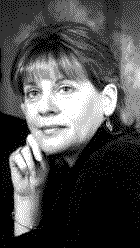 Karen Scott is author of The Internet Writer's Handbook 2001/2 published by Allison & Busby in March. She is also co-author of A Writer's Guide to the Internet published in April 2000. She is a member of The Society of Authors, The Queen's English Society and EPIC. She runs New Writers Consultancy (http://www.new-writers-consultancy.com) a critique and editorial service for writers and Author Network (http://www.author-network.com) a resource site for writers. She has recently established Puff Adder Books (http://www.puff-adder.com) an epublishing company with her partner, Diana Hayden. Email: karen@author-network.com.